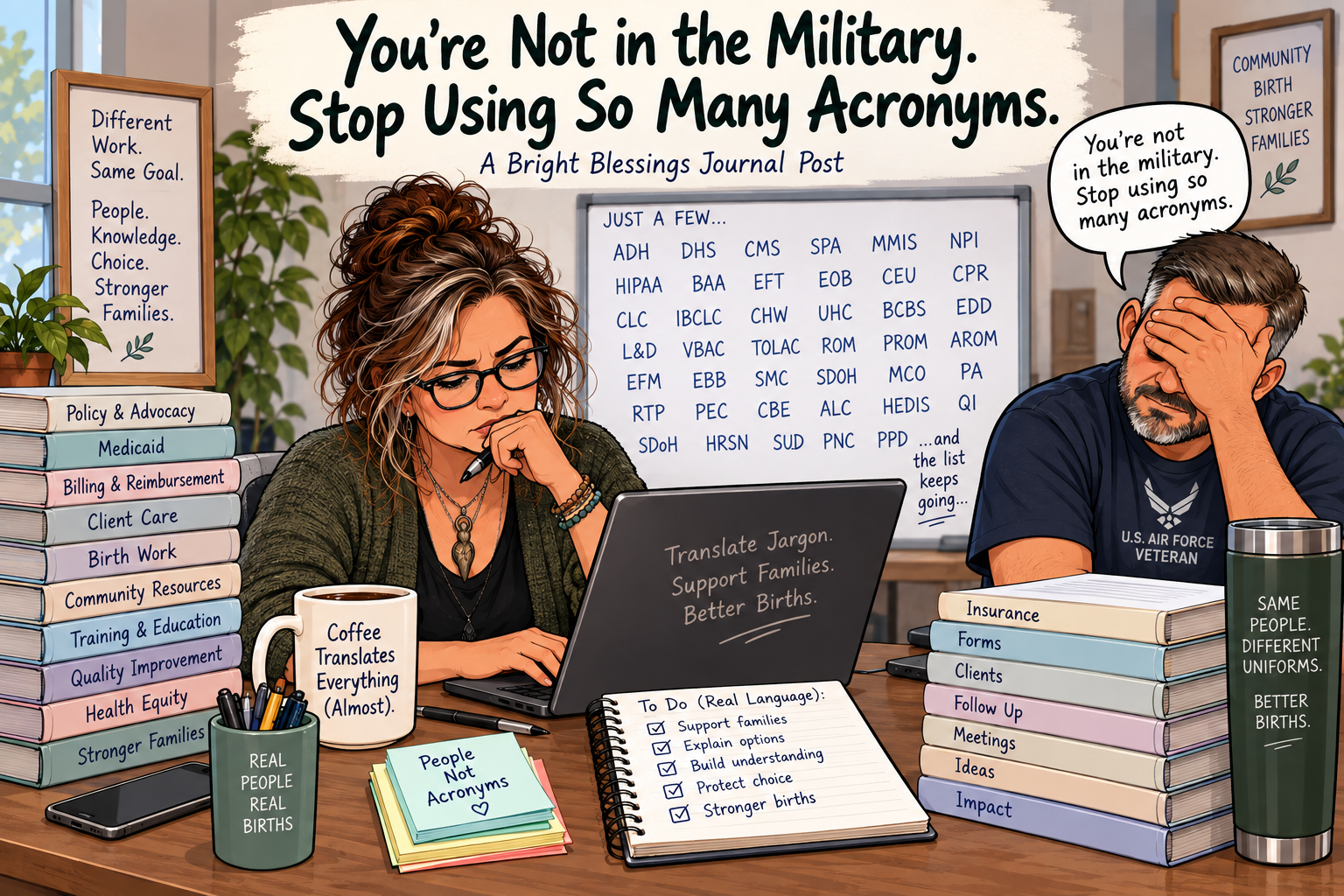
YOU’RE NOT IN THE MILITARY. STOP USING SO MANY ACRONYMS.

A close friend who spent twenty years in the Air Force recently gave me grief about the number of acronyms that seem to have taken over my vocabulary.

His point, to be fair, was not that acronyms are bad.

His point was that if you’re going to use one, you ought to know what it means.

This is a reasonable position.

Unfortunately, I work in healthcare.

We didn’t steal the military’s acronyms.

We developed an entirely separate infestation.

I am a CCBD credentialed through ADH, enrolled with DHS as a Medicaid provider after CMS approved the SPA, and I bill through MMIS using my NPI while worrying about HIPAA, BAAs, EFTs, EOBs, CEUs, CPR, CLC, IBCLC, CHW, UHC, BCBS, SMC, and whatever fresh alphabet soup crawled out of my inbox this morning.

Did you follow all of that?

Congratulations. Either you work in healthcare or you may be eligible for college credit.

And that’s before somebody goes into labor.

Birth work has its own dialect.

There are EDD, L&D, VBAC, TOLAC, ROM, PROM, AROM, EFM, EBB, and BRAIN, just for starters.

At some point we’re not communicating anymore.

We’re playing Scrabble without vowels.

The truly disturbing part is that I understand this stuff.

Someone can say something along the lines of, “The CCBD needs her NPI for MMIS after the CMS SPA approval, but check the EOB before asking DHS about the EFT,” and some horrible part of my brain goes:

Yes. Obviously.

Meanwhile, my close friend is staring at me like I’ve begun transmitting encrypted coordinates to NATO.

And sometimes those of us who work in healthcare and birth forget that normal people don’t speak this language.

An acronym slips into a conversation with a family, and suddenly we have to back up and translate what we just said into actual English.

That’s particularly important in birth work.

Families shouldn’t need a decoder ring to understand what is happening during pregnancy, birth, or postpartum care.

Part of a doula’s job is helping turn the alphabet soup back into language people can actually understand and use.

Because understanding matters.

You can’t meaningfully participate in a conversation when everyone else in the room seems to be speaking in abbreviations.

Acronyms are useful when everyone involved understands what they mean.

When they don’t, they’re just another barrier to understanding.

And part of a doula’s job is helping families get past those barriers.

Of course, while discussing this article with my twenty-year Air Force veteran friend, I made what I thought was a perfectly good joke and referred to all of this as my MOS.

That earned an immediate correction.

MOS is an Army term.

The Air Force uses AFSC.

Fine.

I stand corrected.

So the next time my close friend gives me grief about my alphabet soup, I have my answer ready:

“It’s my AFSC.”

AFSC: Air Force Specialty Code.

See?

Sometimes you really do have to explain the acronym.

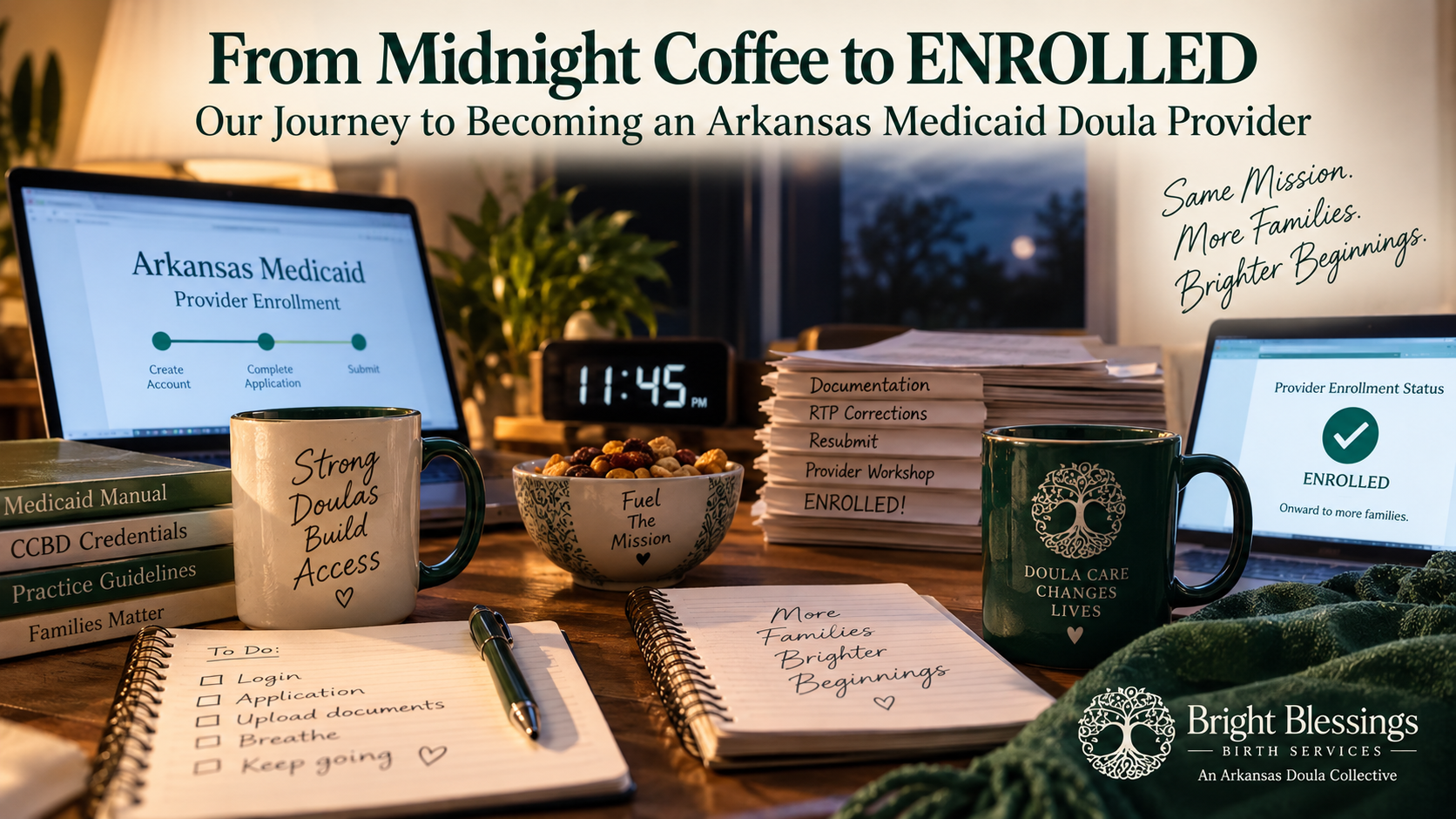
Becoming an Arkansas Medicaid Doula Provider: From Midnight Coffee to ENROLLED

At 11:45 p.m. on August 31, 2026, the coffee was made.

The snacks were ready.

The bodies were exhausted.

But the demand was there. The need was there. And Arkansas Medicaid doula provider enrollment was scheduled to open at midnight.

So Danielle Wright and Annie Hill sat in their own kitchens and home office spaces, computers open and paperwork nearby, poised and ready to log into the Arkansas Medicaid provider enrollment system.

We were going to become Arkansas Medicaid doula providers.

We were prepared.

Or, more accurately, we thought we were prepared.

By about 1:00 a.m., it had become apparent that the application contained questions for which we simply did not yet have answers.

There comes a point in every great administrative adventure when another cup of coffee will no longer reveal the meaning of a government form.

We decided that perhaps the wisest course of action was to stop clicking things, get some sleep, and call Provider Enrollment in the morning.

September 1: Arkansas Medicaid Doula Enrollment Begins

Later that day, Annie and at least three other Certified Community-Based Doulas across Arkansas had submitted their Medicaid provider enrollment applications.

This was brand-new territory.

Arkansas Medicaid had never before enrolled Certified Community-Based Doulas as providers. The doulas applying were new to the system, the provider specialty was new, and everyone involved was learning how the process would work in practice.

We submitted our applications.

Then we waited.

Not for very long.

Because by September 2, we had learned a new acronym.

RTP: Return to Provider

RTP means Return to Provider.

If you have never encountered an RTP notice before, it means Medicaid received your application but found something it wanted corrected, clarified, added, or documented differently before enrollment could continue.

It is not the same thing as a denial.

It is more along the lines of:

We have your paperwork. We would like you to have your paperwork back for a moment.

The early applicants we were communicating with had all encountered some version of the same experience.

And thus began the next stage of becoming some of Arkansas’s first Medicaid-enrolled doulas.

We made phone calls.

We compared notes.

We reread the newly released provider materials.

We corrected applications.

We learned which documents needed to be submitted and how various portions of the application needed to be completed.

We called again.

And we discovered that perhaps the Medicaid enrollment portal should come with either chocolate or a complimentary stress ball.

Possibly both.  And maybe a set of the same for the poor people at AFMC who were to field our phone calls saying “we’ve read the existing documentation, but we have questions…”

Correct, Resubmit, Repeat

Annie’s application was corrected and resubmitted on September 3, 2026.

By this point, something else was becoming clear.

There was not going to be a well-worn path for us to follow because we were among the people making the path.

Arkansas’s Medicaid doula benefit was new.

Arkansas’s Certified Community-Based Doula credential was new.

The Medicaid provider enrollment process for doulas was new.

And when you are among the first people through a new system, sometimes you discover the places where the instructions, the portal, and reality do not quite line up yet.

Those discoveries may be frustrating at one in the morning, but they also make the process easier for the people who come next.

September 8: Learning How to Function as a Medicaid Provider
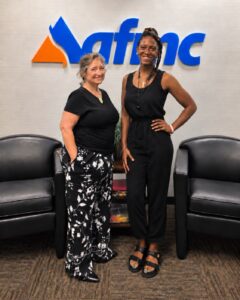
Annie Hill and Danielle Wright attending new provider training.On September 8, Annie and Danielle attended the Arkansas Medicaid New Provider Workshop.

Because becoming enrolled is only the first part.

Once Medicaid says yes, a provider still needs to understand how to function inside the Medicaid system.

That means learning about eligibility verification, documentation, claims, provider portals, billing requirements, covered services, and all the administrative machinery happening behind the scenes.

For Bright Blessings, learning those systems is important for a very simple reason:

Our families should not have to become Medicaid billing experts in order to receive doula care.

Their job is pregnancy.

Their job is preparing for birth.

Their job is recovering postpartum, learning their baby, feeding their baby, asking questions, making decisions, and caring for their families.

The provider paperwork?

That’s our job.

September 9: ENROLLED

Then came September 9, 2026.

Annie logged into the provider system.

And there it was.

ENROLLED.

After the midnight coffee, the application, the RTP, the corrections, the phone calls, the documentation, the resubmission, and a considerable amount of determined persistence, Annie Hill, Arkansas Certified Community-Based Doula #005, officially became an enrolled Arkansas Medicaid doula provider.

There may have been celebrating.

There may also have been a certain amount of staring at the screen just to make sure the word was still there.

It was.

ENROLLED.

Danielle Is Right Behind Her

Danielle Wright, Arkansas Certified Community-Based Doula #008, has been traveling the same road.

Her enrollment encountered additional issues that needed to be identified and corrected. Those problems have now been worked through, and her application has been submitted appropriately.

As of September 16, 2026, Annie has received her Medicaid provider enrollment approval, and we expect Danielle’s approval by Friday, September 18.

To the best of our knowledge as of this publication date, Annie may currently be the only Certified Community-Based Doula serving the Little Rock area whose Arkansas Medicaid provider enrollment has completed.

But Danielle should be right behind her.

And that matters, because Bright Blessings is not being built around one doula.

We are building an Arkansas doula collective.

That means expanding coverage, providing backup for one another, sharing experience, and creating a system in which more Arkansas families can receive consistent community-based doula care.

Arkansas Has a Very Small Number of Certified Community-Based Doulas
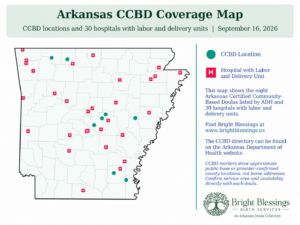
Arkansas map showing CCBD locations and hospitals with labor and delivery units, updated September 16, 2026.At the time this article was published in September 2026, the Arkansas Department of Health listed only eight Certified Community-Based Doulas statewide.

Not eight in Little Rock.

Not eight in Central Arkansas.

Eight across the entire state.

And the words Certified Community-Based Doula, or CCBD, matter.

A person can be a trained doula.

A person can hold certification from a national or independent doula organization.

A doula can be experienced, knowledgeable, and excellent at their work.

A doula can also work for a business or healthcare practice that participates in Medicaid for other services.

None of those things, by themselves, make that individual an Arkansas Certified Community-Based Doula.

For Arkansas Medicaid to reimburse doula services, the individual providing those services must hold the Arkansas CCBD credential and must separately complete Medicaid provider enrollment.

How Does a Doula Become Eligible to Provide Medicaid-Covered Doula Care?

There are two separate steps families should understand.

  1. The doula must become an Arkansas Certified Community-Based Doula, or CCBD. This credential is issued through the Arkansas Department of Health.
  2. The doula must complete Arkansas Medicaid provider enrollment. Holding a CCBD credential makes a doula eligible to pursue Medicaid enrollment, but certification alone does not mean Medicaid enrollment is complete.

Put simply:

CCBD certification first. Medicaid provider enrollment second.

This distinction matters when families are searching for an Arkansas Medicaid doula.

How Families Can Verify an Arkansas CCBD

A clinic, agency, group practice, healthcare organization, or other business may already participate in Arkansas Medicaid for completely unrelated services.

That does not automatically mean that every doula working for that organization is eligible to provide Medicaid-reimbursed doula care.

The credential belongs to the individual doula.

So how can families know?

Start with the Arkansas Department of Health’s official list of Certified Community-Based Doulas.

Look for the individual doula’s name.

If the person is not listed as an Arkansas CCBD, families should ask questions before assuming their doula services can be billed to Medicaid.

It is also important to remember that appearing on the CCBD list does not automatically mean Medicaid provider enrollment has been completed.

The Department of Health list verifies the CCBD credential.

Medicaid enrollment is the next step.

At Bright Blessings, we believe families deserve to know exactly who is providing their care, what credentials that person holds, and whether the services being offered are eligible for Medicaid reimbursement.

Why We Went Through All of This

It would be easy to tell this as a story about forms.

Or portals.

Or RTP notices.

Or staying awake until one o’clock in the morning wondering exactly what a particular box on an application was asking.

But none of those things are why we did it.

We did it because there are Arkansas families who have wanted doula support and simply could not afford to pay for it privately.

We did it because geography and income should not determine whether someone has access to knowledgeable support during pregnancy, labor, birth, and postpartum.

We did it because community-based doulas can help families navigate an increasingly complicated maternity care system.

We did it because families deserve someone who has time to listen.

And we did it because Arkansas Medicaid families now have a benefit that can make that support accessible without asking families already stretching their budgets to somehow find hundreds or thousands of additional dollars for doula care.

Medicaid Doula Care in Little Rock, Searcy, Conway, and Central Arkansas

Bright Blessings Birth Services supports families experiencing both low-risk and high-risk pregnancies.

Our collective serves families throughout Central Arkansas, including Little Rock, Cabot, Jacksonville, Beebe, Searcy, Conway, Lonoke, and surrounding communities.

Our doulas provide nonmedical emotional, physical, informational, practical, and advocacy support throughout pregnancy, labor, birth, and postpartum.

And now we can begin bringing that support to Arkansas Medicaid families who may never before have been able to afford professional doula care.

The Midnight Coffee Was Worth It

On August 31, two exhausted doulas sat in two different homes with coffee, snacks, computers, and absolutely no idea how many times we were about to learn the phrase Return to Provider.

A little more than a week later, the first Bright Blessings doula was officially enrolled.

The second is right behind her.

We learned the system.

We found the problems.

We corrected the applications.

We asked questions.

We kept going.

And perhaps most importantly, the next person through the process will know a little more because those first Arkansas CCBDs went through it first.

That is how new systems become usable.

One question, one correction, one provider, and apparently one pot of coffee at a time.

Bright Blessings Is Now Accepting Arkansas Medicaid Families

Bright Blessings Birth Services is now accepting Medicaid clients.

If you are pregnant and covered by Arkansas Medicaid and are interested in working with a doula, please contact us.

If you are a physician, midwife, nurse, social worker, community organization, church, pregnancy resource provider, public health professional, or anyone else working with pregnant Arkansas families, please share the word.

Families who may never before have been able to afford professional doula support may now have access to it through Arkansas Medicaid.

We look forward to working with them.

Bright Blessings Birth Services
An Arkansas Doula Collective
501-300-5841
brightblessings.us

Exciting news for maternal health and rural families across Arkansas

The Doula Alliance of Arkansas has been awarded $860,500 through Arkansas’s Rural Health Transformation Program for Access Starts at Home: Rural Maternal Care Coordination and Doula Support.

The program will place 10 certified doulas in partner clinics across Northwest, North Central, Upper Delta, Lower Delta, and Southwest Arkansas, helping connect families, doulas, and clinical care teams throughout pregnancy and through six months postpartum. The program will also work in partnership with MySwaddle to help strengthen that connection and continuity of support.

For families living in rural communities, access matters. Distance, transportation, limited local resources, and fewer maternity-care options can all create additional barriers during pregnancy and postpartum. Bringing community-based doula support closer to families is one more way to help bridge those gaps.

Doulas from Bright Blessings Birth Services will be represented at this year’s annual Doula Alliance of Arkansas Conference in Pine Bluff, and we’re looking forward to hearing much more about Access Starts at Home, how the program will be implemented in Arkansas communities, and the role MySwaddle will play in supporting families and care coordination.

Congratulations to the Doula Alliance of Arkansas, and especially to the rural Arkansas families who will ultimately benefit from this investment in maternal health.

#ArkansasDoulas #CommunityBasedDoula #RuralMaternalHealth #MaternalHealth #DoulaSupport #BrightBlessingsBirthServices #DoulaAllianceOfArkansas #ArkansasMaternalHealth

Related: Meet the Bright Blessings team and explore our birth doula support.

What does it mean to be a CCBD?

What does it mean to be a Community-Based Doula?

It means knowing that supporting a family sometimes extends beyond preparing for birth.

A community-based doula knows her community. She knows where to turn when a family needs transportation, food assistance, childbirth education, lactation support, housing resources, mental health services, help navigating healthcare, or support beyond her own scope of practice.

We aren’t expected to solve every problem. We shouldn’t.

But we should know how to help families find the people and resources that can.

At Bright Blessings Birth Services, doula care isn’t about deciding what choices a family should make. It’s about education, connection, advocacy, and making sure families have the information and support they need to make their own informed decisions.

That’s what the community in community-based doula care means to us.

Related: Meet the Bright Blessings team and explore our birth doula support.

Why Choose a Doula in Arkansas?

A doula holding hands with a pregnant person.Pregnancy and birth are not medical emergencies by default.
They are profound, physiological life events that deserve skilled support, informed decision-making, and respectful care.

For families in Arkansas, choosing a doula is not just about comfort. It is about safety, education, and advocacy in a maternity care system that is under strain.

Arkansas Birth Statistics Tell a Story

In Arkansas, approximately 34 percent of births are delivered by cesarean section, a rate higher than both national and evidence-based recommendations. While cesarean birth can be lifesaving when medically necessary, high intervention rates are also associated with increased risks for mothers, longer recovery times, and higher complication rates in future pregnancies.

Arkansas also ranks among the states with the highest maternal mortality rates in the country. Many pregnancy-related deaths have been found to be preventable. Rural families face particular challenges, including long travel distances to hospitals with labor and delivery units and limited access to higher-level care when complications arise.

These realities mean that many Arkansas families enter pregnancy and birth without consistent education, without enough time with their providers, and without someone solely focused on their well-being.

Why This Matters for Arkansas Families

Most prenatal visits are short. Important questions may go unanswered. Concerns may be unintentionally minimized, not because providers do not care, but because the system is stretched thin.

Without adequate education and support, families may not fully understand:

  • What is normal in pregnancy and labor

  • When intervention is truly necessary

  • What informed consent actually means

  • How to communicate concerns effectively in a hospital setting

This gap in care contributes directly to poor maternal outcomes.

What a Doula Does

A doula is a trained, non-medical birth professional who provides continuous emotional, physical, and educational support throughout pregnancy, labor, birth, and the postpartum period.

A doula helps Arkansas families:

  • Prepare for pregnancy and birth with evidence-based education

  • Understand medical options and terminology

  • Navigate hospital birth, homebirth, or birth center care

  • Reduce fear and stress during labor

  • Improve communication with doctors, midwives, and nurses

  • Feel supported, heard, and respected

Research consistently shows that families who work with a doula experience lower cesarean rates, fewer medical interventions, shorter labors, and higher satisfaction with their birth experience.

Doula Support and Medical Care Work Together

Choosing a doula does not mean rejecting obstetric or neonatal care.

High-level medical care is essential when complications arise. The issue is not the existence of advanced care, but the assumption that intervention must be the default rather than the appropriate response.

Doulas support families in understanding risk, recognizing when escalation is needed, and remaining grounded and informed if that escalation occurs. This partnership improves safety, not risk.

A Local Solution to a Statewide Problem

For most of human history, pregnancy and birth were supported by knowledgeable attendants who provided education, reassurance, and skilled presence. Modern doulas carry forward that role while working within today’s medical system.

In a state like Arkansas, where access to maternity care is uneven and outcomes continue to lag, doula care is a protective factor. Listening saves lives. Education reduces risk. Support changes outcomes.

At Bright Blessings, we believe no one should navigate pregnancy or birth alone.

Serving Central Arkansas Families

Bright Blessings Birth Services provides professional doula care and pregnancy support for families across Central Arkansas, including Cabot, Little Rock, Conway, Beebe, Searcy, and surrounding areas in Lonoke, Pulaski, Faulkner, and White counties.

Ready to Learn More?

If you are pregnant, planning a pregnancy, or supporting someone who is, you deserve care that listens first and supports fully.

? Contact Bright Blessings today to learn how doula support can help you approach pregnancy and birth with confidence, knowledge, and peace of mind.

Learn more about doula support

For clinical context, read ACOG’s guidance on partnering with doulas. Explore Bright Blessings doula services and choose your consultation path.

Community-Based Birth Support and Learning in Central Arkansas

A community-focused collaboration supporting doulas and families in Cabot and surrounding towns through ethical, sustainable birth care.

That sentence reflects the heart of my work as a doula and educator in Central Arkansas. It speaks to a belief that birth support, education, and community care work best when they are rooted where people actually live.

Why This Community Matters

Cabot and the surrounding towns are part of a rapidly growing Central Arkansas corridor where families often navigate pregnancy, birth, and postpartum recovery with limited access to consistent, relationship-based support. This region includes rural, suburban, and military-adjacent families who experience real gaps between clinical care, education, and continuity after birth.

A locally rooted collaboration allows doulas to support families in meaningful ways by building trusted referral networks, offering practical education, and responding to the cultural and logistical realities of this community. Rather than relying on broad, statewide solutions, this approach centers care where it can be most effective and sustainable.

The Stone Ridge Learning Center

The Stone Ridge Learning Center, which will be located in Central Arkansas near Cabot at the northern edge of Pulaski County, is a long-held dream that is now beginning to take real shape. It is envisioned as a place for hands-on learning, shared knowledge, and community resilience.

Stone Ridge is being built as a welcoming learning space where practical skills are taught with care and humanity, and where education feels accessible rather than intimidating.

Planned offerings include:

• Birth education and postpartum support
• Doula training and continuing education
• Midwifery skill development
• Herbalism, home remedies, and body literacy
• Canning, food preservation, and homestead skills
• Gardening, soil health, and seed saving
• Traditional crafts and fiber arts
• Classes taught by local teachers, artisans, and elders
• Learning spaces that thrive even when I am not the one teaching

A Place for Shared Knowledge and Ethical Care

At its heart, the Stone Ridge Learning Center is not about building something around a single person. It is about creating a place where knowledge is shared, where people are supported, and where learning happens without shame, competition, or gatekeeping.

In a world that often feels fragmented and overwhelming, this project represents a quiet but deliberate act of hope. Step by step and piece by piece, something steady and life-giving is being built in Central Arkansas.

If you are someone who loves to teach, share skills, or collaborate in ways that support families and community health, I would love to connect when the time is right.

Sometimes the most meaningful response to a difficult world is to create something that helps people care for themselves and each other.

I am looking forward to what this becomes.

Related: Meet the Bright Blessings team and explore our birth doula support.

What a Doula Does and How Doulas Differ from Midwives

As a doula with more than forty years of experience supporting families across the United States, I have learned that clarity brings comfort. Many people still wonder what a doula does, how we fit into a birth team, and how our role differs from that of a midwife. My goal here is to answer those questions and show how compassionate, informed doula care can make a meaningful difference for every family.

What Is a Doula, in Plain Terms

A doula is a trained, nonmedical professional who offers continuous physical, emotional, and informational support before, during, and after childbirth. I do not diagnose, prescribe, or perform medical procedures. I do provide continuous presence, comfort measures, advocacy coaching, and evidence-based information so families can make informed decisions about their care.

How I Show Up for Families

Emotional Steadying

I keep the energy calm and focused. I help partners find words and tasks that soothe, and I remind families of what feels right for them in the moment.

Physical Comfort and Coaching

I offer massage, position suggestions, counterpressure, and breathing and vocal support. These techniques can reduce pain, shorten labors, and lower the need for some interventions.

Evidence-Based Information and Consent Support

I explain procedures in plain language, help families prepare questions for providers, and support them in giving or withholding consent. My role is not to tell a family what to do. My role is to make sure they understand their options.

Continuity and Preparation

I help families create realistic birth plans, rehearse coping strategies, and plan postpartum needs. Continuity matters. Seeing the same supportive face through pregnancy and birth can improve outcomes and satisfaction.

Postpartum Care and Referral

In the weeks after birth, I help with feeding support, gentle hands-on comfort, and links to community resources. I help normalize the emotional shifts that happen after birth and I help spot when someone may need medical or mental health support.

The Difference Between a Doula and a Midwife

Role and Scope

  • Doula: Nonmedical support person who focuses on comfort, information, and advocacy.
  • Midwife: Licensed primary care provider for pregnancy and birth, responsible for prenatal exams, clinical decision making, and, when trained and licensed, delivering babies.

Clinical Responsibilities

  • Doula: Does not perform exams, prescribe medication, interpret fetal monitors, or perform deliveries.  We do translate
  • Midwife: Performs physical assessments, orders tests, manages complications within their scope, and transfers care when necessary.

Legal and Liability Difference

  • Doula: Does not perform exams, prescribe medication, interpret fetal monitors, or perform deliveries. When complex or urgent situations arise, my role is to help parents understand what is happening in language that makes sense to them. I bridge communication between the care team and the family, translating medical terminology and context so they can grasp the gravity of the moment and make informed, confident decisions.
  • Midwife: Licensed clinician with legal and professional responsibilities that carry clinical liability.

Complementary Relationship

A doula and a midwife can be a powerful team. Doulas provide continuous hands-on support, while midwives handle clinical decisions and medical care. Both roles are valuable and distinct.

Why This Clarity Matters

In a world where rumors and misunderstandings spread quickly, clarity protects families and practitioners. I have chosen, repeatedly and publicly, not to practice midwifery in any unlicensed or compensated way. I will not put myself or my clients at legal or medical risk. My commitment is to safe, evidence-based, compassionate support that respects the boundaries of medical practice.

How Doula Care Changes Outcomes

  • Shorter labor
  • Reduced need for certain interventions
  • Higher satisfaction with the birth experience
  • Better breastfeeding outcomes
  • Smoother postpartum adjustment for many families

What matters most to me is not a statistic, but the face of a family who felt supported, seen, and empowered. That is the work I want to keep doing.

If You Are Considering Doula Support

If you are thinking about hiring a doula, these questions can help:

  • What training and certifications do you have?
  • How many births have you attended?
  • What is your approach to emergencies or complications?
  • How will you work with my chosen medical provider?
  • What is included in your fee, and what is your backup plan?

Closing and Invitation

I love this work because it helps people move through threshold moments with more safety and more dignity. If you have questions about how I practice, or about the differences between doulas and midwives, I am always open to honest conversation. My commitment is to clarity, to safety, and to the families I serve.

If you are ready to learn more about how doula care can support your family’s birth or postpartum experience, I invite you to reach out through my book a consultation or schedule a consultation. Every family deserves support that honors both knowledge and intuition.

Learn more about doula support

For clinical context, read ACOG’s guidance on partnering with doulas. Explore Bright Blessings doula services and choose your consultation path.

Great News for Arkansas Families! Doula & Childbirth Education Coverage is Coming

Hello beautiful families!
Annie here from Bright Blessings Birth Services.

I’m so excited to share news that’s truly planting a legacy for maternal care right here in Arkansas! For too long, doula support felt out of reach financially. That’s changing now, and it’s all about planting support, growing families!

Your Doula & Childbirth Education: Insurance Coverage is Coming!

As of August 3, 2025, a new Arkansas law (Act 965) requires private health benefit plans to cover services provided by certified community-based doulas. This is monumental for Arkansas maternal health!

Why August 3, 2025? In Arkansas, new laws become effective 90 days after the legislative session officially ends. Our 95th General Assembly concluded on May 5, 2025, making August 3 the effective date for this vital act.

What This Means For You: Empowered Births & Support!

This law expands access to the personalized emotional, physical, and informational support doulas provide throughout pregnancy, birth, and postpartum. It also recognizes the value of childbirth education in preparing you for a confident and empowering experience. It’s all part of our mission to help you feel rooted and ready, truly planting support, growing families from the very start.

How to Get Your Doula Care Covered: Your Action Plan!

While coverage is mandated, specific reimbursement details depend on your plan. Here’s how to navigate your insurance for doulas:

  1. Verify Your Benefits: Contact your health insurance provider. You can find their number on your insurance card.
  2. Key Questions to Ask: Inquire about reimbursement rates, service limits, physician referrals, claim submission processes (superbill), and any applicable CPT codes.
  3. Understand the Superbill: You’ll typically pay your doula directly (which may change in the future as health plans start including Doulas in their network, but right now they have no one in network which creates an exemption). After services, you’ll receive a detailed “superbill” to submit to your insurer for reimbursement.
  4. Choose a Certified Doula: The law applies to certified community-based doulas. When selecting your doula, ensure they hold recognized certifications that align with the standards of the Doula Alliance of Arkansas. Their accepted certification training organizations include: Birthing Advocacy Doulas Training, CAPPA, Cornerstone Doula Training, DONA, Madriella, National Black Doulas Association, ProDoula, Stillbirthday, and Ujima Maternity Network.

    As your doula at Bright Blessings Birth Services, I proudly hold certifications from both Madriella and Stillbirthday, two respected organizations on this list. With deep expertise gained as the trusted lead trainer for the Madriella Doula Network from 2013-2020, where I trained many doulas now serving Arkansas, I bring experience and wisdom to guide families. This ensures you’re working with a qualified professional whose doula services fall under this new mandate.

Your Journey, Brighter Than Ever!

This new law is a testament to the vital role doulas in Arkansas play in improving outcomes. It’s a huge step toward making this personalized support accessible. We are so excited to continue planting support, growing families across our community.

I am so thrilled about what this means for you. If you have questions about my services or navigating doula insurance coverage, please do not hesitate to reach out!

Wishing you bright blessings on your journey,

Angela M. “Annie” Hill
Certified FullSpectrum Doula & Childbirth Educator
Bright Blessings Birth Services
Website: brightblessings.us
Email: annie@brightblessings.us
Phone: 314-328-9662

How Doulas Make a Difference in Arkansas

A sleeping newborn resting against an adult’s chest.Arkansas faces a tough reality with its maternal mortality rate, the highest in the U.S. at 43.5 deaths per 100,000 live births from 2018 to 2020, per the Kaiser Family Foundation. Rural areas see it hit even harder, and the Arkansas Maternal Mortality Review Committee notes 92% of these deaths are preventable. A key issue is inadequate support during labor, delivery, and postpartum. With rural hospitals closing OB units, many moms are left navigating early labor or postpartum challenges with little guidance, a gap that’s costing lives.

Doulas are stepping up to fill that space, offering a lifeline where the system falls short – a fact seen by Arkansas State leadership and supported by major education institutions and hospitals like UAMS.

Doulas offer comfort measures and help families communicate with their care team. Position changes and tools such as a peanut ball may be used when appropriate, with guidance from the clinical team. They do not guarantee a particular birth outcome.

After birth, doulas can provide emotional support, practical information, and connections to community resources. Concerns about depression, anxiety, or physical recovery need assessment by an appropriate healthcare professional.

Arkansas’ maternal health crisis calls for action. A new state law requires health plans to cover doula services alongside Medicaid, opening doors for more families. Yet, with only 60 days of postpartum Medicaid coverage, short of the year many experts recommend, there’s still work to do. Doulas offer consistent care, advocating for moms through every stage, from early labor to postpartum healing. It’s not just about numbers, it’s about lives. 

The 92% preventable death rate is a wake-up call. At Bright Blessings, we’re part of the solution, sharing decades of experience to make birth safer for Arkansas families.

Evidence note — October 2026: Continuous labor support has benefits, but research on doula care and severe maternal illness or mortality remains limited. See ACOG’s guidance on partnering with doulas.

Arkansas’s New Doula Certification Act: What It Means for a Doula here

Hands applying lower-back pressure during pregnancy, with the Bright Blessings logo.In my last blog, I covered two other bills from Arkansas regarding coverage by Medicaid for Doulas in Arkansas.  This time I’m covering further big news from Arkansas – the state legislature has moved forward with House Bill 1252, the Certified Community-Based Doula Certification Act. This is a game-changer for doula care in our state, and here’s what it could mean for those of us committed to supporting mothers through their journey into parenthood.

What’s in the Bill?

Certification and Recognition:
    • Age Requirement: You must be at least 18 to become a certified community-based doula.
    • Certification Pathways: You can get certified through organizations designated by the Arkansas Department of Health or through the Doula Alliance of Arkansas. This gives us flexibility but also means we need to keep an eye on which organizations are recognized.
    • Certification Renewal:  Every two years, we’ll need to renew our certification with the required professional development. This commitment to growth is essential, but we must ensure that training remains accessible and relevant. Continuing education units (CEUs) are vital in any profession, and ours is no exception.
Scope of Practice:
    • The bill outlines what we can do – from childbirth education to advocacy, system navigation, resource connection, and providing continuous support during labor and intermittent support in the prenatal and postpartum phases. It’s comprehensive but leaves room for how these services might be interpreted in practice.
Compensation:
    • Finally, Recognition! The bill ensures that certified doulas will be compensated by both Medicaid and health benefit plans. This is huge for making doula care accessible to more families. However:
        • The Fine Print: The exact services covered, especially in hospital settings, will be determined by future rules from the Department of Human Services. We need to stay involved to ensure these rules reflect the full spectrum of our work.
          The Doula Alliance of Arkansas is on top of this but it’s our job as Doula’s to be informed autonomously as well in order to provide excellence in care, and for those to be more than just buzzwords.
Registry for Doulas:
    • A public registry will be created, which could help families find certified doulas but it also means we’ll need to be mindful of privacy.
Accountability:
    • Certification can be suspended or revoked for unethical practices or non-compliance. While it’s good to have standards, They’ll want to ensure the process for handling such cases is fair and transparent.
Confidentiality:
    • Our work with families will be kept confidential under this bill, which is crucial for trust. However, we must be vigilant about understanding and adhering to these confidentiality rules to avoid any unintended breaches.

What Could Be Better?

    • Service Coverage: There’s some ambiguity in what services will be reimbursed, particularly in different birth settings. We’ll need to advocate for comprehensive coverage.
    • Professional Development: While it’s beneficial, we need to ensure the required training is accessible to all doulas, regardless of their background or location.
    • Certification Organizations:  Certification bodies must be inclusive and truly reflective of our diverse community. Bias of any kind cannot be tolerated. Our role is to support those who are expecting and to help new families navigate unfamiliar waters—but that commitment must be embraced from the top down. Only then can we create meaningful change in Arkansas, where maternal and neonatal mortality rates remain alarmingly high.
    • Compensation Details: The bill doesn’t specify rates, so we’ll need to push for fair compensation that reflects the value of our work.  We can’t be legislated into spending a lot of money for training and continued education, and then be placed into a position where we can’t afford to cover our own bills…
    • Implementation: With rules still to be set by the end of 2025, there’s a window for us to influence how this bill is put into action.

Next Steps for Doulas

    • Stay Engaged: Keep up with the rule-making process to advocate for comprehensive service coverage.
    • Advocate: Work with organizations like the Doula Alliance of Arkansas to ensure certification is accessible and fair.
    • Educate: Use this as an opportunity for professional growth, but also to educate families on what this means for doula care access.

This bill is a step in the right direction for doula recognition and support in Arkansas. It’s up to us to make sure it translates into real, tangible benefits for both doulas and the families we serve. Let’s keep the conversation going and make sure every mother who needs a doula can have one, supported by the new legislation that Governor Sanders has championed.

The Next Step for this Bill:
This bill has passed through and goes to the House committee for Public Health, Welfare, and Labor on Tuesday February 25.  Here is a list of members who are listed on the agenda for being on committee that day:

Rep. Jeff Wardlaw, Chair: Represents District 94.
Rep. Jeremy Wooldridge, Vice-Chair: Represents District 1.
Rep. Aaron Pilkington: Represents District 42.
Rep. Bart Schulz: Represents District 31.
Rep. Mark Perry: Represents District 66.
Rep. Kendra Moore: Represents District 23.
Rep. Stephen Magie: Represents District 56.
Rep. Lee Johnson: Represents District 47.
Rep. Ryan A. Rose: Represents District 48.
Rep. Jack Ladyman: Represents District 53.
Rep. Cameron Cooper: Represents District 44.
Rep. Zack Gramlich: Represents District 50.
Rep. Mary Bentley: Represents District 54.
Rep. Jay Richardson: Represents District 49.
Rep. Glenn Barnes: Represents District 65.
Rep. Kenneth B. Ferguson: Represents District 13.
Rep. Denise Jones Ennett: Represents District 80.
Rep. Dolly Henley: Represents District 32.
Rep. Fred Allen: Represents District 77.
Rep. Wayne Long: Represents District 39.

What YOU can do as a Doula or a family member who wants this to pass:  Pick up the phone and call your representative’s office if those listed are on it, and even if they aren’t – you can easily say you are a person who believes in this bill and the difference it will make in the lives of families in Arkansas.   HB1252 needs our support and the elected officials need to know what their constituents have to say on it.