

Good morning, Annie here.
My day frequently starts before I ever crawl out of bed.
Sometimes it is a text that came in overnight. Sometimes it is something I see on social media. Sometimes something lands in front of me that touches a subject I care deeply about, and suddenly I am working before my feet have even touched the floor.
That is pretty normal for me.
Also pretty normal for me? Getting passionate about something and accidentally writing a small novel about it.
So I apologize in advance for the novel-length post.
I felt strongly enough about this one that I wanted to take the time to write it. I would love for you to read it if you have the time. I also completely understand if your morning does not have room for one of Annie’s accidental dissertations about maternity care.
This morning, a Reel about epidurals, Pitocin, evidence-based medicine, social media, birth plans, and patient trust got my brain going.
And here’s the frustrating part:
I agreed with quite a bit of it.
Evidence matters.
Clinical education matters.
Experience matters.
Having a large social media following does not make someone a medical expert.
A video telling every pregnant person to refuse Pitocin, refuse an epidural, refuse an induction, or refuse some other intervention is not individualized care.
Birth plans are not scripts. Circumstances change.
Pitocin has legitimate medical uses.
Epidurals are a valuable form of pain relief for many people.
Sometimes the safest birth looks very different from the birth somebody envisioned during pregnancy.
And evidence-based medicine absolutely must allow for individual patient circumstances and nuance.
Yes.
Exactly.
But that last sentence is also where I start getting frustrated.
The patient is part of the nuance
“Individual patient circumstances and nuance” cannot refer only to a diagnosis, a fetal monitor strip, laboratory results, medication protocols, or what generally happens on a particular labor and delivery unit.
The individual patient is actually in there somewhere.
Her circumstances include her medical history.
They also include her previous experiences.
Her fears.
Her values.
Her cultural and family history.
What happened during her last birth.
What makes her feel safe.
What makes her feel vulnerable.
How she experiences pain.
What she has already told us matters to her.
And what information she needs before she is comfortable making a decision.
The patient experience is part of the nuance.
That does not compete with evidence-based medicine.
It is part of it.
Evidence-based medicine has never meant research evidence alone. It brings together the best available evidence, clinical expertise, and the individual patient’s values and circumstances.
ACOG’s own guidance on informed consent and shared decision-making describes care in much the same way: risks and benefits should be considered within the context of the patient’s values and priorities.
ACOG: Informed Consent and Shared Decision Making in Obstetrics and Gynecology
TikTok did not invent this distrust
If thousands upon thousands of women are talking with one another about feeling frightened, pressured, dismissed, inadequately informed, unheard, or traumatized during maternity care, eventually we have to ask something besides:
“Who on social media is teaching women not to trust doctors?”
We also need to ask:
“Why was there enough distrust for that message to resonate in the first place?”
Because this conversation did not begin with TikTok.
It did not begin with Instagram.
It did not begin when Facebook Reels became a thing.
Some of us are old enough to remember women having these same conversations on AOL boards, email lists, message boards, pregnancy forums, and early online communities.
And before the internet?
Women told their birth stories around kitchen tables.
They talked in childbirth classes.
They talked at church.
They talked at work.
They talked to sisters, mothers, aunts, neighbors, and friends.
Women have always told one another about birth.
They talked about beautiful births.
They also talked about traumatic ones.
They talked about epidurals that did not give them the experience or relief they expected.
They talked about difficult inductions.
They talked about feeling pressured into interventions.
They talked about not understanding what had happened until afterward.
And they talked about not being listened to.
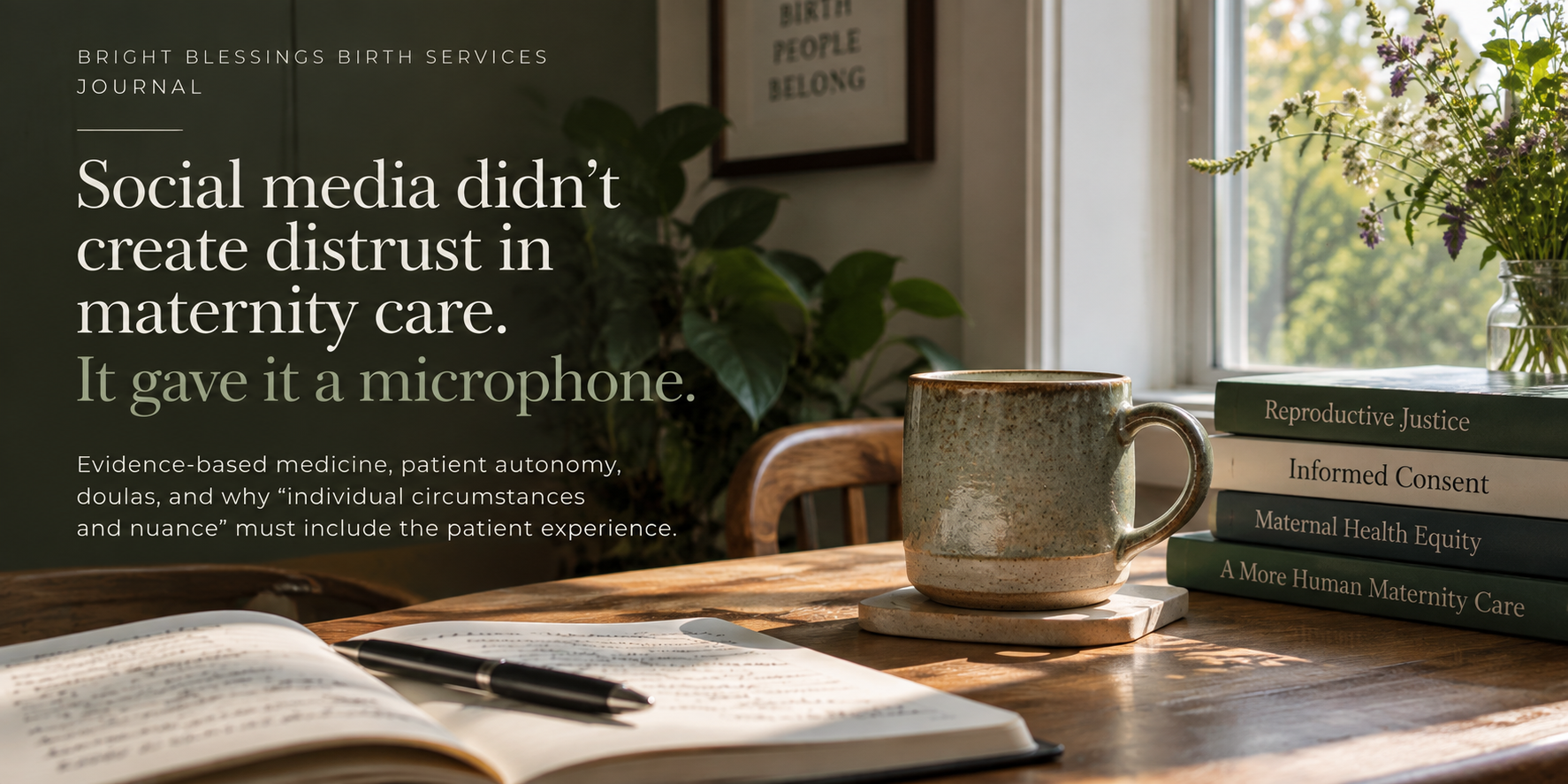
Social media did not invent those experiences.
It gave them a microphone.
That distinction matters.
Misinformation is real. So are the experiences underneath it.
Let me be very clear about something.
There is bad pregnancy information on social media.
There is sensationalized information.
There are people giving medical advice who are not qualified to give it.
There are blanket statements telling pregnant people never to accept an intervention that may sometimes be necessary or lifesaving.
I have a problem with that too.
A frightening TikTok is not a substitute for individualized medical advice.
But neither should we leap from “medical misinformation exists online” to “women distrust maternity care because social media frightened them.”
Those are two very different statements.
Sometimes misinformation finds an audience precisely because somebody’s previous experience has already taught her not to trust the system.
If that is happening, correcting the misinformation is important.
But so is asking why she was prepared to believe it.
We have evidence that not everyone feels heard
We do not have to rely entirely on anecdotes to know there is a problem.
In a 2023 CDC survey, about one in five mothers reported experiencing mistreatment during maternity care. The proportion was approximately 30% among Black, Hispanic, and multiracial respondents.
Nearly 45% of respondents said they had held back from asking questions or discussing concerns with their maternity-care provider.
Among the reasons women gave were worrying that their provider would think they were difficult, feeling that their provider seemed rushed, and not feeling confident that they knew what they were talking about.
CDC: Maternity Care Experiences
https://www.cdc.gov/mmwr/volumes/72/wr/mm7235e1.htm
Sit with that for a minute.
Almost half said they had held something back.
That is not a TikTok statistic.
That is a communication problem.
And it should concern every one of us who works in maternity care.
Race cannot be separated from this conversation
We also cannot talk seriously about trust in American maternity care without talking about race.
The latest national maternal mortality data available from the CDC show that in 2024, the maternal mortality rate for non-Hispanic Black women was 44.8 deaths per 100,000 live births, compared with 14.2 for non-Hispanic White women.
CDC: Maternal Mortality Rates in the United States, 2024
https://www.cdc.gov/nchs/data/hestat/hestat113.htm
Those numbers do not mean every Black woman will receive poor care.
They do not mean every White physician is biased.
They do not mean every hospital is unsafe.
But they do mean that a Black woman who knows these statistics is not irrational for asking hard questions about her care.
And there is evidence that bias can affect medical judgment.
Research has documented racial bias in pain assessment and treatment recommendations, including false beliefs about biological differences between Black and White patients among some medical trainees.
PubMed: Racial bias in pain assessment and treatment recommendations
Black and Indigenous families also bring historical, community, and individual experiences with medicine into the room with them.
Those experiences do not disappear because the clinician standing in front of them is kind, competent, and genuinely wants to help.
Trust cannot simply be demanded because somebody has MD after their name.
Modern medicine has also changed who can become pregnant
There is another piece of the maternal mortality conversation that deserves nuance.
Modern medicine has accomplished extraordinary things.
People with congenital heart disease, serious childhood illnesses, complex medical histories, and chronic conditions are surviving into adulthood, living full lives, and becoming pregnant when previous generations may not have had that opportunity or may have been advised that pregnancy was simply too dangerous.
That is one of medicine’s great successes.
It also means today’s pregnant population includes people with medical histories that can make pregnancy more complex.
That matters when we talk about maternal outcomes.
But recognizing medical complexity does not somehow erase racial disparities, failures of communication, mistreatment, or bias.
More than one thing can be true at the same time.
We should be sophisticated enough to hold all of them.
And then there are the interventions everyone argues about
Epidurals are not evil.
Pitocin is not evil.
Cesareans are not evil.
Inductions are not evil.
And an unmedicated vaginal birth is not morally superior to any of them.
Every one of those things is a tool or an outcome that may be appropriate in a particular situation.
The problem begins when maternity care is turned into competing camps.
One side says:
“Never let them do that to you.”
The other says:
“Stop listening to people online and trust your doctor.”
Neither answer leaves much room for the person actually giving birth.
What I would rather hear is:
Why is this being recommended?
What problem are we trying to solve?
What are the expected benefits?
What are the risks?
Are there alternatives?
What happens if we wait?
How urgently do we need to decide?
Those are not anti-medical questions.
They are not evidence that somebody has been poisoned against medicine by social media.
They are part of informed consent.
ACOG explicitly states that informed consent requires adequate, accurate, understandable information and the freedom to ask questions and make a voluntary choice. That choice can include accepting or declining recommended treatment.
Shared decision-making considers the risks and benefits of the available options in the context of the patient’s own values and priorities.
ACOG: Informed Consent and Shared Decision Making in Obstetrics and Gynecology
That is important.
Because autonomy does not mean automatically saying no.
Choosing the epidural can be autonomy.
Choosing Pitocin can be autonomy.
Choosing induction can be autonomy.
Changing your mind during labor can be autonomy.
Saying, “I don’t want that right now,” can also be autonomy.
The goal should never be teaching patients automatically to say no.
But neither should the goal be teaching them automatically to say yes.
This is where doulas belong in the conversation
And yes, I am going to talk about doulas.
A doula is not an obstetrician.
A doula does not diagnose.
A doula does not prescribe.
A doula does not replace a nurse.
A doula does not interpret a fetal monitor instead of the clinical team.
A doula should not tell a client that her physician is wrong or instruct her to refuse medically recommended treatment.
That is not our job.
But sometimes the person standing in the room who has spent hours prenatally learning what matters to the patient is the doula.
We may know what happened during her previous birth.
We may know that one particular experience frightened her enough that she has worried about it for months.
We may know the questions she wanted to remember to ask.
We may notice when the woman who was asking questions ten minutes ago suddenly stops speaking.
We can help her remember what she wanted to know.
We can help her formulate a question.
We can help her understand that circumstances have changed and that it may be time to gather new information and make a new decision.
We can help her stay connected to the conversation when the birth she imagined is no longer the birth that is happening.
That does not make the doula the medical expert.
It means the doula brings a different kind of support to the team.
And continuous labor support itself has been studied.
A Cochrane review involving more than 15,000 women found that continuous support during labor was associated with several beneficial outcomes, with support from someone experienced and present solely to provide labor support, such as a doula, appearing particularly beneficial.
Cochrane: Continuous Support for Women During Childbirth
So when we talk about “individual circumstances and nuance,” I find it frustrating when doulas are treated as though we are inherently part of the problem.
A good doula should be helping create individualized care, not fighting against it.
A birth plan is not a contract with the universe
This is another place where I think both sides sometimes talk past one another.
Of course birth plans change.
Birth itself has never promised to follow the agenda.
A person can spend months planning an unmedicated vaginal birth and then develop preeclampsia.
A baby can show signs that change the risk calculation.
Labor can stall.
A patient can become exhausted.
Someone who swore she never wanted an epidural can decide that she wants one.
Someone who planned to avoid Pitocin can hear the reason it is being recommended and decide that it makes sense.
None of that means her birth plan “failed.”
And none of it means autonomy disappeared because circumstances changed.
When the clinical circumstances change, the conversation changes.
A changed situation should lead to a new informed decision.
The patient’s prenatal preferences do not override what she wants now.
That is the point.
The plan was never supposed to control the birth.
It was supposed to help everyone understand the person.
Trust has to be built
This is where I keep coming back.
If patients are walking into hospitals frightened and distrustful, we absolutely should correct misinformation.
But we also need to listen to where the fear came from.
Because trust is not restored by repeatedly telling people that medical professionals are the experts and therefore deserve to be trusted.
Trust is restored by being trustworthy.
It is built when patients are listened to.
When questions are answered without condescension.
When concerns are investigated rather than reflexively dismissed.
When clinicians can say, “I don’t know,” when something is genuinely uncertain.
When recommendations are explained.
When informed consent is treated as an ongoing process rather than a signature on a form.
When changing circumstances are explained instead of simply announced.
When the person in the bed remains part of the conversation about what happens to the person in the bed.
And when a patient who asks difficult questions is not immediately categorized as anti-doctor, anti-hospital, anti-science, or the latest victim of social-media hysteria.
Sometimes she is simply trying very hard to make an informed decision about one of the most consequential experiences of her life.
It should not be us versus them
At Bright Blessings, I do not want an adversarial relationship between doulas and medical professionals.
- I do not want families taught to fear obstetricians.
- I do not want obstetricians taught to fear doulas.
- I do not want nurses caught somewhere in the middle.
- That helps absolutely no one.
- I want collaborative maternity care.
- I want evidence-based medicine.
- I want skilled physicians.
- I want experienced nurses.
- I want excellent midwives.
- I want competent doulas who understand their scope.
- I want patients who feel safe asking questions.
- I want medical professionals whose expertise is respected.
And I want families to understand that respecting medical expertise and retaining autonomy over their own bodies are not opposing ideas.
Those things belong together.
We can challenge misinformation without dismissing the experiences that made people vulnerable to it.
We can celebrate extraordinary obstetric care without pretending poor obstetric care does not exist.
We can acknowledge that clinicians possess knowledge their patients do not without pretending that patients bring nothing important to the table.
We can recognize that social media sometimes spreads fear while also recognizing that it has given people a place to tell stories that previously went unheard.
And when thousands of people are telling us they do not trust the system, we can spend all of our energy trying to convince them that they are wrong.
Or we can become curious about why.
I think maternity care desperately needs more of that curiosity.
Because the solution to an “us versus them” mentality is not figuring out which side is right.
It is remembering that there shouldn’t be sides.
Sources and further reading
ACOG: Informed Consent and Shared Decision Making in Obstetrics and Gynecology
CDC: Maternity Care Experiences
CDC: Maternal Mortality Rates in the United States, 2024
PubMed: Racial bias in pain assessment and treatment recommendations