At the end of May, I sat down with Katherine Stephens of Made For Birth for a conversation I have wanted families, new doulas, and even experienced birth workers to hear. As an Arkansas Certified Community-Based Doula, doula trainer, and retired home birth midwife, I wanted to make the work behind doula care visible.
What does it actually take for a doula to be available when a client goes into labor at 2 a.m., on a holiday, or several weeks earlier than expected?
The answer is much more than showing up.
Episode 115 of the Made For Birth podcast, “More Than Showing Up: The Logistics of Doula Work with Annie Hill,” was released on August 14. Katherine and I talked in depth about the work families see, the work they never see, and what allows a doula to offer skilled, ethical, dependable support over the long term.
A doula is not simply a supportive friend
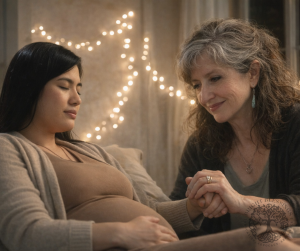
Emotional reassurance, encouragement, cool washcloths, position changes, and hands-on comfort all matter. They are part of doula care, but they are not the whole of it.
An experienced doula also brings critical thinking, communication skills, birth education, advocacy tools, professional boundaries, and the ability to remain steady when a family feels overwhelmed.
A doula is not a miniature midwife. We do not diagnose, perform clinical assessments, or make medical decisions for our clients. We are a nonclinical bridge between the family and the clinical care team. We help families understand what they are hearing, identify the questions they want to ask, and remain active participants in their own care.
The work begins long before labor
In the episode, I describe preparing individualized educational materials for a client who wanted to understand her options but became overwhelmed when given too many choices at once. Good support is not measured by how much information a doula can pour onto someone. It is measured by whether the information is useful, understandable, and matched to that family’s actual needs.
Prenatal doula work can include:
- Learning how a client processes information and makes decisions
- Preparing the partner to take an active, confident role
- Attending a prenatal appointment when that support would help
- Explaining birth terminology and common procedures in plain language
- Practicing questions a client may want to ask the care team
- Planning for labor, postpartum recovery, feeding, visitors, and household support
- Building backup coverage before it is ever needed
As I said during the interview, “A good doula will educate and empower.” The goal is not to make a family dependent upon me. The goal is to help them feel informed, grounded, and capable of using their own voice.
Recognition is not diagnosis
One of the most important distinctions in doula work is the line between recognizing a concern and diagnosing a condition.
At Bright Blessings, we often say, “We don’t catch babies; we catch problems before they become emergencies.” That does not mean practicing medicine. It means listening carefully, recognizing when something deserves prompt attention, and encouraging the client to contact the appropriate healthcare professional.
A skilled doula knows how to say, “This may be worth discussing with your provider,” without turning concern into panic. We help clients communicate what they are experiencing and make sure the clinical team has the opportunity to evaluate it.
Doulas support partners, too
A doula is not there to replace a spouse or partner. We help partners understand what is happening, give them practical ways to support the laboring person, and step in where they need information, reassurance, rest, or another pair of hands.
Sometimes that means teaching a hip squeeze. Sometimes it means helping a partner recognize that the family wants more information before making a decision. Sometimes it means quietly reminding both people that they have time to breathe and ask another question.
Sustainability is part of ethical care
The episode also addresses something birth work does not discuss honestly enough: a calling still needs a sustainable structure.
Reliable doula care requires on-call planning, backup doulas, childcare and family arrangements, transportation, continuing education, protected health information practices, contracts, documentation, insurance credentialing, billing systems, and fees that allow the doula to remain in practice.
It also requires rest, peer support, appropriate debriefing, and a life outside birth work. Burned-out doulas cannot provide the steady presence families deserve. Taking care of our own physical, emotional, and financial needs is not selfish. It is part of maintaining safe, dependable care.
This interview was recorded while Arkansas was still building the systems needed to put Act 965 into practice. Some administrative details have continued to move since our conversation, but the central issue has not changed. Access to doula care must expand, and the doulas providing that care must be able to sustain the work.
Maternal sovereignty is the foundation
Near the end of our conversation, Katherine asked me to explain the Maternal Sovereignty Method.
At its core, it is active listening followed by thoughtful implementation. It begins with recognizing that the client is a sovereign person. Her values, history, nervous system, family, risks, hopes, and decisions belong at the center of her care.
Informed consent is not a form someone signs. It is an ongoing process of receiving understandable information, asking questions, considering options, and making a voluntary decision.
That is the work beneath the visible work. It is why doula care is more than showing up.
Listen to the conversation
Listen to Episode 115, “More Than Showing Up: The Logistics of Doula Work with Annie Hill,” on Made For Birth. The episode is also available through Apple Podcasts and Spotify.
If you are pregnant in Central or North Central Arkansas and want to talk about what skilled doula support could look like for your family, visit Bright Blessings Birth Services to schedule a clarity call.
Angela “Annie” Hill
Owner, Bright Blessings Birth Services
Arkansas Department of Health Certified Community-Based Doula #005
Related: Meet the Bright Blessings team and explore our birth doula support.